Seven Reasons to Consider Homeschooling after Covid19
 Whether it was in anyone’s plans or not, every family in the United States that has school age children has now experienced a taste of homeschooling. However, to be fair, those of you who were forced into this situation were not able to experience what it is like to be a homeschooling family that has time to plan ahead, order the materials that best suits your students, organize field trips, or take part in the co-ops and enrichment programs that are offered to homeschooling students. Most of you experienced distance learning in a stressful environment. In many situations both mom and dad have been working from home and in between the Covid19 restrictions and sharing computers and WIFI (while arbitrating phone, t-v, and video game usage), the experience has been less than ideal. On the other hand, some of you have enjoyed the benefits of getting to know one another again. You’ve spent quality time together and that’s been great. You may have discovered how quickly your students can get their school work done without having to change classrooms, share a teacher with 20+ others, or wait for disruptions to be handled. There are more than a few families who have been paying quite a bit for private school and some of you are now realizing that if you invest that same amount of money in a creative academic plan (one that could easily include trips to places of interest as well as purchasing equipment to enhance learning) homeschooling might be a preferred choice!
What are the benefits of continuing to homeschool your students? Let me share a few primary reasons that many us homeschool our kiddos.
- Homeschooling encourages having a close knit family. I have nine children, all grown now, who are truly great friends. When my youngest daughter was in a near fatal wreck in Texas several years ago 7 of her 8 siblings were there with us
 within 24 hours (coming from TN, FL, TX and CO). Although they did experience their share of sibling rivalry and silly arguments while growing up, they have been there for each other in time of need as well as in time of celebration.
 - Homeschooling allows for designing an educational program that best fits your student’s learning style, interests, and, in many cases, learning disabilities. You are in control of the materials ordered and used. There are many, many products available to help parents with this process. In addition to a wide variety of materials to purchase, there are also many educational websites, videos and more. So much is offered either for free or at very affordable prices, that almost every family can afford to homeschool.
- Homeschooling families have flexible schedules. You can begin when you want and end when you want. You can get up at a certain time and have everyone dressed and ready or you can stay in your PJs until you decide everyone needs to get dressed. Several of our sons participated in Civil Air Patrol and they often conducted search and rescues at all hours of the day and night. They appreciated having the
 homeschooled students in the unit because we were more likely to allow our students to take part in a search and rescue at any hour because we knew they could catch up on sleep or school work at another time. If you homeschool you will not be rushing out the door to get to the school (or to a bus stop) and you do not have to make sure your students are picked up (or brought home) each day, five days a week. No packing lunches (or providing lunch money). You want to take a vacation? Schedule it! If your parents are sick and in need of your help, you and your
 children can be there for them. Are there conferences and camps you would like to attend? Schedule it!
 - Contrary to the age old concern, “What about socialization?” you will discover that one of your biggest challenges as a homeschooling family may be coordinating the schedule of events because you may find that your students will want to participate in athletic activities, music, theater, dance, speech and debate, STEM clubs, Lego clubs, co-ops, and more! Our family homeschooled co-op style and met once a week with several other families where children of various ages learned together. It was a preferred socialization experience when compared to having 20+ eight-year-olds all in the same room, all day. Homeschooled students, for the most part, adapt very easily to a variety of situations.
- How well do homeschooled students do in college and/or careers after high school? Glad you asked! The proof is in the pudding. Research shows that the average college exam scores and GPAs are higher for homeschooled students. So many
 colleges have experienced how well homeschooled students do on campus that they seek out homeschooled students. In fact, my position was created at Bryan College for this purpose! When parents are intentional about preparing their students to succeed after high school, and when students are equally invested, the results are often quite impressive.
 - Outside of the siblings bickering, there is little peer pressure and no bullying when you homeschool. Your students will not be exposed to school shootings. They will thrive in a safe environment. Anxiety, stress, and depression are likely to be reduced.
- If you have a child with an amazing talent who needs hours on end of training, practice, competition or performance, then choosing to homeschool is definitely the best option. This is the exception, and not the rule, but it is another great reason to homeschool!
Because of our flexible schedule, homeschooling allowed my children to take part in many additional activities they would not have been able to experience had they been enrolled in traditional school. They have visited foreign countries, campaigned in several states, attended and worked at several different camps, helped the homeless, protested unfair laws, gone to many conferences and conventions, started businesses, volunteered to help with hurricane clean up, and so much more. When a new niece or nephew is born, they try to be there. When a brother or sister is in need, they show up. When grandparents needed help, they were there. Now that my husband and I are getting older, we are blessed by our children’s care for us (their help is usually needed when experiencing technology issues). Although we know that our children are not who they are solely because of our homeschooling experience, we do know that it has made a big difference in their lives. Should you decide to continue to homeschool, talk to your homeschooling friends to find out what programs are offered in your area. You may be pleasantly surprised at how rewarding this choice can be for you and your children!


 Last August (or September) the new school year began and everyone was excited and off to a good start. Fall soon arrived, and the cooler weather was invigorating. And then, before you knew it, it was time to celebrate Thanksgiving and then Christmas! (This year, with Thanksgiving being celebrated so late in the month, these two holidays fall almost back-to-back.) After Christmas the fun and excitement wains and the clean-up begins! Before you know it, the new year will begin and it’s time to get back to the books, resuming a regular schedule. For some families this transition is easy and exciting (particularly for those who function much better on daily routine), while for others — well, let’s just say they’d rather stay in bed with a good book, putting things off for another day or two. If you fall into the later category, this article is for you!

 Some students know from an early age exactly which college they plan to attend and they never waver! Others are not so sure they even want to attend college. Many students are open to looking at all options and would appreciate help narrowing down their choices. Choosing a college is not a decision lightly made and many agonize over this decision, yet armed with the right questions, the fields can be narrowed down to two or three top choices by a student’s junior year in high school.
 your visit.
 College visits: The best time to visit a campus is when classes are in session, but try to avoid exam week, if possible. You can visit when classes are out of session, but the visit will be better if that can be avoided. Being on campus while students are on campus and being able to sit in on classes are experiences that weigh heavily on the decision making process. In order to make the most of a college visit, call the department of admissions and find out if the college has a visit coordinator on campus. Ask when the visit days are available (you may be able to find this information on the college website). Ask to attend classes and talk with faculty. Tour the campus. Eat in the cafeteria. Observe current students and, if you have the opportunity, stop and talk to the students. Meet with the admissions office and financial aid. Ask about the application process and scholarship opportunities. Be prepared with questions to ask so you get all the information you need.
 Many homeschooled students take dual enrollment classes, earning both college credit and high school credit at the same time. This is a great option assuming your students can handle college level classes, keep up with assignments, and pass the class. However, in addition to student readiness, there are additional facts to consider before proceeding.
 to lose. However, that is not the case. If a student fails to pass a class with a certain GPA there will be negative consequences. Many of the states that offer free, or reduced, dual enrollment classes often have stipulations that have to be met in order to continue receiving free (or reduced tuition) classes. These grants are lost if a student does not earn a high enough GPA in the class and, in some states, there is no way to regain the dual enrollment grant. If a student takes a class and does poorly, then losing the opportunity to continue taking college classes during high school for free (or at a discounted price) could be a costly mistake. Not only does the student lose the grant, but the parent could then become responsible to pay for the failed class out-of-pocket.
 Academic scholarships for freshmen are often determined by the students’ GPA and earned test scores (ACT, SAT and/or CLT). High school students who have a high GPA prior to taking DE classes could lower their GPA if they perform poorly in college classes. If a GPA is lowered to the degree that scholarships are reduced (or lost), then the “free” classes were not free after all.
 Because I homeschooled my students for 32+ years I have many friends who finished their homeschooling adventure long before I finally finished. One of the often heard regrets has to do with allowing high school students to attend college classes on a secular campus. The environment that students will be exposed to on a secular campus will be far different than the environment of a Christian campus. Yes, I am well aware that there are students on Christian campuses who do not live Christ-like lives but, hopefully, that will not be the norm. Not only should you be careful about the curriculum used on secular campuses (especially the literature assigned), but the worldview of the instructor could make a huge impact on your student, especially if he or she is an atheist with a pronounced agenda to debunk Christianity. Parents should not be sheltering their students 24/7, but they do need to be careful about putting students in certain situations before they are mature enough to handle those situations. Taking online courses may be preferable to on-campus classes, but if the courses are taught at a secular campus, then the material might conflict with your beliefs (depending on the class). Most homeschooling families have been so careful about making wise academic choices that it is surprising at how quickly many enroll their students in secular classes simply because of financial considerations. Please do not think that I am saying a parent should never allow students to take classes at a secular institution. Several of my children took both dual enrollment classes at secular campuses and two earned degrees from secular campuses. This is not a black-and-white, always do this or never do that conversation. You know your child better than anyone so prepare, plan, and pray that you will have the ability to steer your students on a course that is best for their future.
 Don Blanton, co-author of the book Personal Economic Model, has designed a three hour college course that will help students understand everything they need to know about the financial world. Using visuals that are interactive, this course takes you from questioning, “Why work?” to helping your student plan wisely to lead a productive and responsible life from high school graduation to retirement (and past retirement age for those who do not choose to retire).


 The largest college scholarship amounts awarded to students are generally academic scholarships. In light of the that, having your students do whatever they can to increase their academic scholarship is a worthy goal. In addition to college scholarships, there are often additional grants, programs and events that come with funds for college. Below are a few suggestions to consider in order to make college affordable.
 earned. (You will see the words “generally,” “usually,” and “often” because this information may vary with each college.)
 for admission, as well as for scholarship awards, are Christian colleges, but not all. This exam is the
  is
is  scholarship money is first come, first serve so being in the pool as soon as possible is a definite advantage. If your student is a senior and you have not done this, do it soon!
 with a 3.5 GPA can then earn their masters degree tuition free. That’s a huge advantage and one that will end up saving a student a lot of money. Every college is similar in many ways, but no two are exactly alike so be sure to find out everything you can about the colleges your students are pursuing.
 high as possible. Scholarships are tied to the GPA as well as to the college exam score.
 also offers a tuition-free Master’s degree to students who come to Bryan after high school and graduate with a 3.5 GPA. And, of importance to seniors, Bryan College hosts two scholarship events per year (one each semester) for qualified seniors who have been accepted to Bryan, allowing them to earn an additional $500 to a full ride for attending and participating.
 After homeschooling my nine kiddos for 32+ years, one of my regrets is not getting involved with a speech and debate club until my 5th child was in high school. We homeschooled co-op style, using unit studies, and we required our children to give presentations weekly and, as a consequence, my children developed public speaking skills. My oldest daughter even won a state-wide speech contest in high school and received a $1,500 scholarship. But debate? We didn’t include debate until a Christian, homeschool speech and debate conference came to our town and I attended a session on the importance of teaching debate skills.
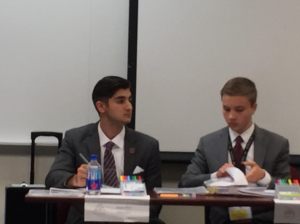 If you have never been involved in speech and debate then I would highly recommend you either visit a club or volunteer to be a community judge at a tournament (or both)! If you live in an area where there are no clubs near by, it may be worth traveling to find out more so that you can start your own club. Becoming a part of a speech and debate club became a non-negotiable parental mandate in our home. As mentioned above, I did not not require my children compete unless they wanted to, but if had to do it over, I would probably make competition a requirement, at least for one year. (And, from what I hear, most students who compete, rarely discontinue competing.)
 Homeschooled Students for Bryan College